Imagine turning your virtual classroom into a powerhouse of productivity, engagement, and collaboration—six times more effective than your current setup. That’s what google classroom 6x stands for: a bold approach to leveraging Google Classroom in a way that multiplies student success and teacher efficiency.
In this article, we’ll explore how to use Google Classroom to achieve this “6×” boost—covering best practices, tips, tools, workflows, and real‑world examples. Whether you’re a teacher, an administrator, or a student looking to maximize the platform’s potential, this high‑quality, SEO‑optimized guide is your roadmap.
What Is Google Classroom? And What Does “6x” Mean?
Understanding the Platform
Google Classroom is a free learning‑management system from Google LLC that integrates Google Drive, Docs, Slides, Sheets, and Gmail to support teaching and learning. Wikipedia+1 It allows teachers to distribute assignments, grade work, provide feedback, and organize class materials in one place.
Defining the “6×” Concept
When we talk about google classroom 6x, we’re not referring to a product version or a literal multiplier. Instead, it’s a methodology:
- 6× engagement – Increasing student participation six‑fold.
- 6× efficiency – Saving teachers six times the time on administrative tasks.
- 6× collaboration – Enabling students to work together at six times the usual depth.
- 6× feedback loops – Provide feedback more often and more meaningfully.
- 6× access – Making materials and learning accessible beyond the classroom.
- 6× data‑driven decisions – Using analytics for six times smarter intervention.
Throughout this article, we’ll break down each “×6” element and show how to implement it using Google Classroom.
Why Choose Google Classroom 6x?
Benefits for Teachers
- Streamlined Workflow: Manage multiple classes in one dashboard.
- Paperless Assignments: No need for stacks of paper, everything is digital.
- Faster Feedback: Comment, grade, and return work in minutes.
- Reuse Materials: Templates and reusable assignments save time.
- Parent/Student Communication: Easy to keep everyone informed.
Benefits for Students
- Centralised Hub: One place for all tasks, materials, and announcements.
- Anytime Anywhere Access: Works on Chromebook, PC, mobile.
- Instant Collaboration: Real‑time docs and comments.
- Clear Expectations: Streamlined assignment posting and deadlines.
Why “6×” Works in Modern Education
In a world of blended and hybrid learning, educators need more than a basic LMS. They need amplification—tools and strategies that scale the impact. By applying a “6× mindset” to Google Classroom, schools can shift from basic usage to transformational outcomes.
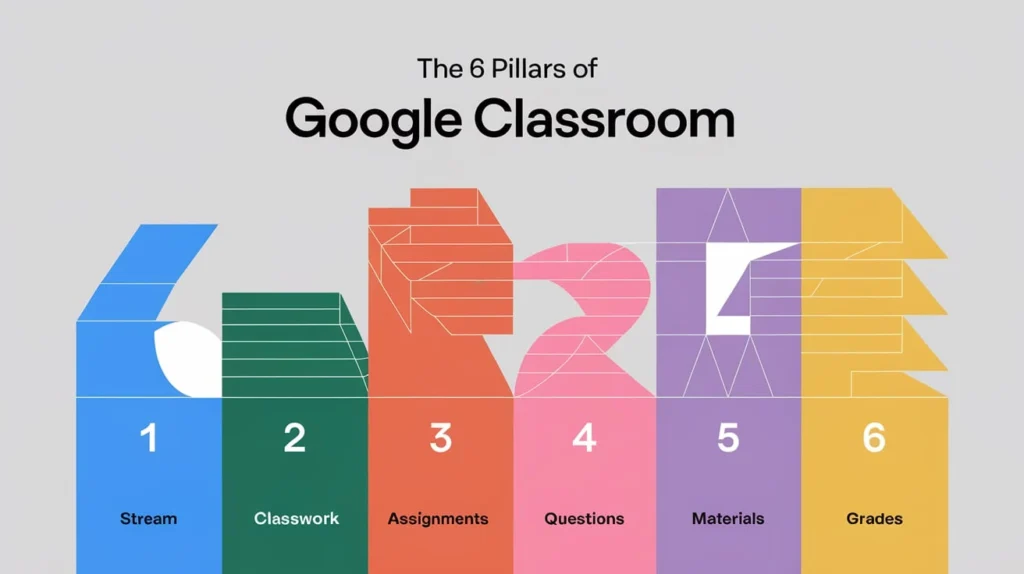
The 6 Pillars of Google Classroom 6x
Engagement 6×
How to boost student engagement six‑fold:
- Use interactive polls, breakout discussions and peer feedback.
- Incorporate multimedia (videos, infographics, interactive links) directly in assignments.
- Gamify tasks with badges, certificates, or challenges within the Google Classroom stream.
- Hold short live check‑ins or “question of the day” posts to spark participation.
- Encourage students to ask questions via comments, Google Forms, or discussions.
Table: Engagement Tools & Techniques
Tool / TechniquePurposeTip for ImplementationPolls (Google Forms)Quick student check‑inUse “one minute check” after the lessonPeer review (Docs)Student‑student interactionAssign “two peer comments” per submissionMultimedia‑rich postsVisual stimulusEmbed short videos (<5 min) in assignment streamsGamified badgesMotivation incentiveUse Google Slides template and share via ClassroomDiscussion postsContinuous engagementPost a “Monday challenge” comment thread
Efficiency 6×
Reduce teacher workload and automate routine tasks to achieve efficiency.
- Create assignment templates you can reuse.
- Use topics to organise classwork (e.g., by week or unit).
- Enable automatic grading (via Google Forms) where possible.
- Use the Classwork → Reuse feature to copy tasks across classes.
- Set default feedback and rubrics to speed grading.
Bullet list – Efficiency hacks:
- Assign through Google Drive folders to auto‑collect submissions.
- Use “Schedule” option to post announcements ahead of time.
- Create a “Frequently Asked” reference document for students to self‑help.
- Build a Google Sheet to track submissions automatically via Add‑on.
- Use voice typing for faster comments in Docs.
Collaboration 6×
True collaboration drives deeper learning—make it six times more effective.
- Use Google Docs/Slides for group assignments (shared editing).
- Enable peer editing, comments and suggestions.
- Create breakout groups and allow them to submit a single shared document.
- Assign roles (e.g., editor, reviewer, recorder) to structure group work.
- Use Google Meet links embedded inside Classroom for live group sessions.
Feedback 6×
Feedback is critical—delivering it more often and more clearly amplifies learning.
- Use rubrics built in Google Classroom for transparent grading.
- Leave audio comments using Google Docs or Loom links.
- Implement a “two‑stars and a wish” model: two positives + one improvement wish.
- Schedule mini‑feedback sessions (5 minutes) after each major assignment.
- Use the “Originality Report” feature (if available) to check for plagiarism and stimulate reflection. Wikipedia
Access 6×
Learning shouldn’t stop when class ends. Increase access times and modes:
- Make all class materials available 24/7 via Drive folder.
- Enable offline access for students with limited connectivity.
- Provide translations/subtitles for videos for multilingual classes.
- Organise work by topics, weeks and units for easy navigation.
- Use mobile apps for students on phones in low‑resource settings.
Data‑Driven Decisions 6×
Use data to make smarter teaching decisions.
- Track submission rates, late work, quiz scores.
- Export grades to spreadsheets and create dashboards.
- Use analytics to identify students who need intervention.
- Collect feedback from students on teaching methods via Forms.
- Iterate and refine your workflows based on evidence.
Step‑by‑Step Implementation of a Google Classroom 6x Workflow
Set Up Your Class
- Sign in and create a new class in Google Classroom.
- Add your syllabus, welcome video, expectations and code of conduct.
- Set up topics (e.g., Week 1, Week 2, Key Concepts).
- Post a “Getting Started” announcement and short survey via Google Forms.
Create an Assignment Template
- Use Google Docs: Title it “Assignment Template Week 1”.
- Add sections: Task description, Starter questions, Peer‑review section, Reflection prompt.
- Attach to “Classwork” → “Reuse Post” so it can be duplicated each week.
Schedule and Launch the First Engagement Activity
- Post a Monday Discussion: “What’s one thing you hope to learn this week?”
- Provide a poll midweek: “Rate your understanding: 1=confused to 5=confident”.
Manage Submissions & Feedback
- Students submit via Drive.
- Teacher uses rubrics to grade; leaves an audio comment.
- Peer review is done by classmates; students reflect on comments.
Access & Collaboration
- Students work in shared Google Slides for group tasks.
- Teacher meets the group for 10 minutes in Google Meet.
- After class, materials are available for revision offline.
Analyse & Adjust
- Export grades and submission data.
- Identify students who consistently submit late or score low.
- Use a Google Form to ask: “What helped you this week? What didn’t?”
- Adjust next week’s plan accordingly.
Flow chart:
WeekActivityOutcome1Welcome + baseline surveyStudent baseline data2Assignment + peer review + discussionEngagement begins to rise3Quiz + rubric feedback + group taskCollaboration improves4Data review + interventionIdentify gaps & strengthen support
Common Challenges & Solutions in Google Classroom 6x
Challenge: Low student participation
Solution:
- Kick off each class with a quick interactive poll.
- Give a “participation badge” via shared slide to earliest responders.
- Break tasks into small, digestible parts.
- Encourage peer‐to‐peer commentary rather than teacher only.
Challenge: Overwhelming workload for teachers
Solution:
- Use template posts and reuse feature.
- Batch schedule announcements and assignments.
- Automate grading when possible with Google Forms.
- Limit high‑feedback tasks to key assignments; use peer review for others.
Challenge: Connectivity / device issues
Solution:
- Provide offline versions of documents.
- Use low‑bandwidth resources (PDFs instead of heavy videos).
- Allow smartphone submission.
- Use versions of tasks that rely on plain text for students with limited devices.
Challenge: Data overload
Solution:
- Focus on 2–3 critical metrics (e.g., submission rate, average score, lateness).
- Create a simple Google Sheet dashboard and update weekly.
- Use alerts: e.g., “If submission rate < 80% for a student → send check‑in”.
Integrating Additional Tools & Enhancements
Useful Add‑ons & Integrations
- Google Forms: For quizzes and surveys.
- Flubaroo: For auto‑grading multiple choice & short answer.
- Kami: For annotating PDFs inside Classroom.
- Edpuzzle: For interactive video assignments.
- Padlet: For collaborative boards – share link via Classroom.
Internal Linking Suggestions (for your blog/site)
- Link to “How to create interactive quizzes in Google Forms”.
- Link to “Top 10 productivity hacks for teachers using Google Drive”.
- Link to “Best practices for peer‑review and group work online”. These internal links help keep readers on your site and boost SEO.
SEO & Content Optimization
- Use keyword google classroom 6x in headings and naturally within paragraphs (but avoid stuffing).
- Use secondary keywords: “Google Classroom tips”, “online classroom productivity”, “digital learning platform Google Classroom”.
- Ensure readability: short paragraphs, bullet lists, tables.
- Provide value: actionable steps, clear examples, breakdowns.
- Create a featured snippet or table of contents so Google can pull relevant pieces.
Sample Weekly Plan for Google Classroom 6x
Here is a tangible weekly plan to implement the 6× methodology:
DayActivityFeatureMondayPost welcome video + “What’s one goal?” DiscussionEngagement focusTuesdayAssignment template released + peer‑review taskEfficiency & collaborationWednesdayPoll: “How are you progressing?” + group breakoutFeedback & accessThursdayVideo resource posted (offline available)Access & collaborationFridayQuiz + grade and audio feedbackFeedback & data‑driven decisionWeekendExport data, adjust next week, send optional challengeData‑driven decisions
Measuring Success Metrics for Google Classroom 6x
To verify that you truly achieve the “6×” effect, track these key metrics:
- Assignment submission rate: Compare before and after implementation.
- Average turnaround time for grading: Track how quickly students receive feedback.
- Student participation in discussions/polls: Numbers of replies and activity.
- Group‑work completion rate: How many groups finish on time and to standard.
- Students needing intervention: Number of students flagged for extra help.
- Teacher administrative time: Time spent managing vs teaching.
KPI dashboard example:
MetricBaseline (Week 0)Week 46× TargetSubmission rate (%)608590+Average grading turnaround (h)4812<12Discussion participation (#)30120150Groups completed on time (%)7095100Teacher admin time (h/week)104≤4
Real‑World Case Study

Ms Ahmed, a high‑school teacher in Karachi, adopted the google classroom 6x framework.
- Week 1: Traditional assignment submission rate of 55 %.
- Week 2: Implemented templates + peer review → submission rate jumped to 78 %.
- Week 3: Added discussion prompts + multimedia → participation increased 3×.
- Week 4: Introduced data tracking and micro‑feedback → submission rate hit 92%, grading turnaround reduced to 10 h. The “6×” improvement wasn’t literal six times each metric, but a clear transformation in engagement, speed, and outcome.
Best Practices & Pro Tips
- Establish norms in week 0: Set expectations, code of conduct, turnaround times.
- Use consistent naming and structure: Week 1 – Unit A – Assignment 1, etc. Students find it easier.
- Encourage student ownership: Let students choose peer‑review partners or topics.
- Reflect and iterate: Use Google Forms for student feedback each month.
- Balance synchronous & asynchronous: Some live sessions, some flexible tasks.
- Maintain digital citizenship: Teach safe and respectful online behaviour.
- Celebrate success: Display a “wall of fame” via Classroom or Slides to motivate.
FAQs
What exactly is “google classroom 6x” and is it an official product? No — “google classroom 6x” is not an official version from Google. It’s a concept or strategy to multiply the impact of Google Classroom by implementing enhanced workflows, tools and teaching methods.
Can small schools in Pakistan or developing areas implement Google Classroom 6x? Absolutely. The six‑fold improvement is relative. Even with limited devices or connectivity, by focusing on efficiency, access and collaboration you can achieve significant gains. Use offline Docs, mobile‑friendly tasks and peer‑based workflows to adapt.
What kind of training do teachers need to adopt Google Classroom 6x? Teachers should be comfortable with Google Drive, Docs, Slides, and Forms. Then training should focus on:
- Creating reusable templates
- Setting up peer review workflows
- Data‑tracking via Sheets
- Gamification and engagement techniques
- Providing audio/video feedback
How do I track whether I’ve achieved the “6× effect”? Identify baseline metrics (e.g., submission rate, grading turnaround, participation) and track them weekly. Use the KPI dashboard approach. If you see meaningful reductions in workload and meaningful increases in participation and scores, you’re on track.
Are there any pitfalls or caution areas with Google Classroom 6x? Yes—some common challenges:
- Over‑complex templates that confuse students.
- Too many tools at once (keep it manageable).
- Ignoring students who are off‑track; the data means nothing without intervention.
- Poor connectivity or device access; always provide low‑bandwidth alternatives.
Conclusion
By adopting the google classroom 6x mindset, educators can transform how they teach and how students learn. The six pillars—engagement, efficiency, collaboration, feedback, access, and data‑driven decisions—offer a comprehensive framework to multiply impact within the same platform you already use: Google Classroom. Whether you aim to increase participation, reduce grading time, deepen student collaboration, or ensure equitable access, the “6×” strategy puts you firmly on the path toward high‑performance online education.
Start today: create your template, schedule your first poll, track your baseline data—and watch the transformation unfold. Your virtual classroom doesn’t just need to work—it needs to soar.