In today’s digital landscape, the importance of reliable data protection cannot be overstated. As we step into 2025, the stakes for businesses and individuals alike have never been higher — and that’s where cloud backup services 2025 come into focus. Whether you’re a small business owner in Karachi, an enterprise IT manager, or simply someone wanting to protect personal files, choosing the right cloud backup solution is key to future‑proofing your data. In this article, we’ll explore why cloud backup matters in 2025, what features define the top services, how to choose wisely, the major trends shaping the market, and practical tips for implementation.
What Are Cloud Backup Services?
Definition and Core Concepts
“Cloud backup services” refer to solutions that store copies of your data (files, systems, applications) on remote servers accessible via the internet, rather than solely relying on local hardware (hard drives, on‑premises servers). According to recent guides:
- They allow automated backup schedules, versioning, off‑site storage and recovery capabilities. N2W Software+2superfast-it.com+2
- They differ from simple cloud storage (where you manually store files) because they include backup workflows, retention policies, recovery tools, and dedicated infrastructure. TechTarget
Why Cloud Backup Services Matter in 2025
Several key drivers make cloud backup services critical today:
- The explosion of data creation (from devices, IoT, remote workers).
- Higher risk of cyberattacks, ransomware, and human error.
- Regulatory and compliance demands (data sovereignty, retention rules).
- The move from purely on‑premises to hybrid and multi‑cloud architectures.
A recent article comparing cloud backup vs local backup summarizes well:
“Cloud backups offer off‑site redundancy, automation, highly scalable access … local backups offer speed but are vulnerable to physical threats.” superfast-it.com
Therefore, when we talk about cloud backup services 2025, we’re looking at advanced solutions built for today’s threats, scale and complexity.
Key Features to Look for in Cloud Backup Services 2025
When evaluating cloud backup services in 2025, here are the must‑have features. These features form both your checklist and your differentiators.
| Feature | Why It Matters | What to Look For |
| Automation / Scheduling | Manual backups are error‑prone and may be skipped. Automation ensures consistent protection. N2W Software | Scheduled backups (hourly/daily), change‑detection, automatic retention management. |
| Immutable / Air‑gapped storage | To defend against ransomware that might delete or encrypt backups. Corptec Technology Partners+1 | Immutable lock periods, backup copies isolated from production network. |
| Hybrid & Multi‑Cloud support | Many organizations have on‑prem + cloud + SaaS; backup must span those. Corptec Technology Partners+1 | Ability to cover on‑prem servers, public cloud VMs, SaaS apps, unified dashboard. |
| Strong encryption & security | Data breaches, compliance require high security. superfast-it.com | AES‑256 encryption at rest & in transit, zero‑knowledge, two‑factor authentication. |
| Recovery speed and flexibility | Backup is only useful if you can restore quickly and reliably. | Support for full‑system restores, rapid file restores, test drills. |
| Tiered storage / cost‑control | Data volumes keep growing; unmanaged cost is a risk. blog.probax.io | Cold/archival tier options, predictable pricing, usage dashboards. |
| SaaS & container‑aware backup | Modern workloads include SaaS apps and containers. Corptec Technology Partners+1 | Support for Microsoft 365, Google Workspace, Kubernetes, container volumes. |
| Compliance & data sovereignty | Regulatory needs vary by geography and industry. | Regional storage locations, audit logs, certified providers (SOC 2, ISO 27001). |
Top Trends Shaping Cloud Backup Services 2025
Understanding trends gives you strategic insight into how backup services are evolving — and how you should plan.
AI‑Driven Automation & Analytics
Artificial Intelligence (AI) and Machine Learning (ML) are being embedded in backup solutions to:
- Detect anomalies (e.g., incomplete backups, ransomware footprints). Corptec Technology Partners+1
- Automate discovery of new assets across cloud and hybrid environments. eon.io
- Provide predictive analytics (e.g., estimate RPOs/RTOs, identify weak links)
Hybrid & Multi‑Cloud Adoption
Very few organizations remain cloud‑only or on‑premises‑only. According to a recent blog:
“89% of enterprises have adopted multi‑cloud strategies, 73% hybrid cloud.” Corptec Technology Partners
This means backup services must support many environments and unify management rather than being siloed.
Immutability, Air‑Gaps & Ransomware Resilience
With ransomware sophistication increasing, backups themselves are targets. Trends include:
- Immutable backup copies (cannot be altered). Corptec Technology Partners
- Air‑gapped copies (isolated from production network).
- Backup workflows integrated into cybersecurity frameworks.
Tiered Storage, Cost‑Optimization & Sustainability
The cost of storing ever‑growing data is real. Backup services in 2025 emphasize:
- Tiering (hot/warm/cold storage) to optimize cost. blog.probax.io+1
- Providers making green/cloud‑native sustainability commitments. Future Market Insights
SaaS & Container‑Native Backup
More applications run in SaaS form or containerized environments (Kubernetes). Backup services now support:
- SaaS application protection (e.g., mail, contacts, files). The Hacker News
- Container‑native backups (persistent volumes, application state). Corptec Technology Partners
Data as an Asset — Backup for More Than Recovery
Backup data is no longer just a safety net; it’s becoming a resource. For example:
- Used for analytics, compliance reporting, migrations. eon.io
- Backups structured into “data lakes” for reuse across the business.
How to Choose the Right Cloud Backup Service in 2025
Selecting is about aligning with your environment, risk profile, budget and future‑strategy. Here’s a step‑by‑step guide.
Assess Your Environment & Risk
- Inventory your data assets: on‑prem servers, cloud VMs, SaaS apps, endpoints.
- Identify business‑critical systems and their recovery priorities (RPO/RTO).
- Determine regulatory or compliance obligations (e.g., data residency).
- Assess current gaps: Do you test restores? Are backups visible? eon.io
Define Your Requirements
Based on the assessment, define required features:
- Multi‑cloud/hybrid capability?
- Immutable or air‑gapped storage needed?
- Must support container workloads or SaaS apps?
- What budget constraints or cost‑controls?
- What security/compliance certifications needed?
Compare Providers
When evaluating providers/services, look at:
- Data restore performance (how fast you can recover).
- Service Level Agreements (SLAs) around backup success and restore.
- Cost model: storage + egress + API fees + archive tiers.
- Ease of use: dashboards, monitoring, alerting, automation.
- Vendor lock‑in risk (can you export your backups?).
- Support, geographic diversity of data centres, data sovereignty.
Consider Hybrid Strategy
Often the optimal strategy is hybrid: local backup for fast restores + cloud backup for resilience/off‑site. For example, the “3‑2‑1” rule:
3 copies of data ▶ 2 different media ▶ 1 copy off‑site. superfast-it.com
Using cloud backup services alongside on‑prem backups gives both speed and safety.
Test It — Don’t Assume It Works
- Regular restore drills: ensure you can recover what you think you can. eon.io
- Monitor backup health and success rates.
- Review your retention, versioning, and data lifecycle policies.
- Update your backup plan as systems change (e.g., new SaaS apps, containerised workloads).
Pricing, Business Models & Cost Considerations
Understanding pricing and cost structure is key to avoid surprises down the line.
- Most cloud backup services are priced on storage used (GB/TB), frequency of access (hot vs cold), number of workloads protected.
- Egress fees (data retrieval) can be significant — check for high‑cost retrieval scenarios.
- Tiered storage (archival, cold) helps cost control for older data. blog.probax.io
- Some providers may offer subscription models, others pay‑as‑you‑go.
- For businesses in Pakistan or similar regions, consider currency, local data sovereignty, latency, and bandwidth costs.
Practical Use‑Cases & Scenarios for 2025
Here are several real‑world scenarios showing how cloud backup services are being used — and should be used — in 2025.
Small Business with Hybrid Setup
A Karachi‑based SME has on‑premises file server + uses cloud apps (Office 365). They choose a backup service that:
- Backs up the file server nightly to the cloud, with incremental backups.
- Integrates with Office 365 to back up mail, contacts, files.
- Has immutable backups to protect against ransomware.
- Allows for file‑level restore for quick recovery and full‑system restore if needed.
Enterprise Multi‑Cloud + SaaS Environment
An organization with AWS, Azure VMs, Kubernetes clusters and SaaS apps. They need:
- A unified backup solution that covers all clouds and on‑prem.
- Container‑aware backups (persistant volumes + application state). Corptec Technology Partners
- Strong automation for discovery of new resources and policy enforcement. eon.io
- Tiered storage to manage cost across large data volumes.
Regulated Industry
Here the demands include: data residency, auditability, compliance, fast recovery. Backup service must:
- Store data in region‑compliant locations.
- Provide audit logs, role‑based access, encryption.
- Provide immutability and air‑gap to satisfy cyber‑insurance and regulation.
Pros & Cons: Cloud Backup Services 2025
Pros
- High scalability — you can grow without buying lots of hardware.
- Off‑site protection reduces risk from local disasters (fire, flood, theft).
- Unified management across diverse workloads (if chosen wisely).
- Increasing automation and intelligence reduces manual effort.
- Access from anywhere (useful for remote work, distributed teams).
Cons / Considerations
- Dependence on internet connectivity (slow or unreliable links may hamper backups/restores). superfast-it.com
- Recurring costs vs one‑time hardware investment — must budget accordingly.
- Potential vendor lock‑in if migration or export isn’t easy.
- Data transfer (egress) costs may be high in some cases.
- Not all backup services treat newer workload types (containers, SaaS) equally — must ensure feature‑fit.
Checklist: Before You Commit to a Cloud Backup Service
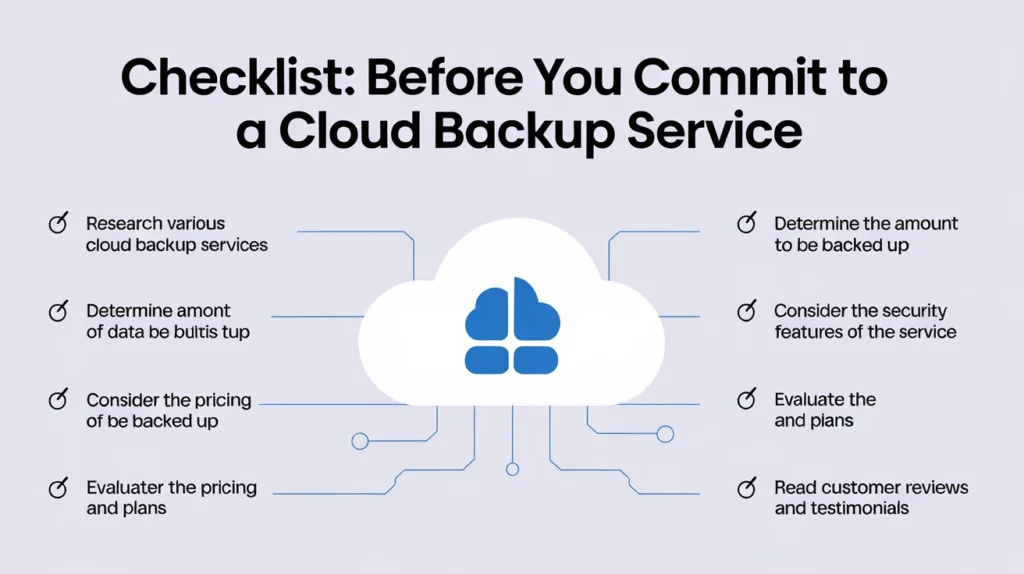
Use this checklist to ensure you’re selecting a solution properly:
- Does it support all your workloads (on‑prem, cloud VMs, SaaS, containers)?
- Is restore tested and reliable? Can you meet your RPO/RTO targets?
- Is the service secure (encryption at transit/rest, immutability, air‑gap)?
- Are pricing, cost controls and storage tiers well‑understood?
- Does it allow export/out migration if you change providers?
- Are regional data centres available (for latency, data sovereignty)?
- Does it provide centralised dashboard and automation for management?
- Are audit logs, compliance features (role‑based access, access logging) available?
- Have you considered hybrid strategy (local + cloud)?
- Have you performed a backup & restore drill to validate the setup?
Internal Linking Suggestions
If this article appears on your website or blog, consider linking to these topics for better navigation and SEO:
- Link to your article on Disaster Recovery Strategies for SMEs when discussing hybrid backup.
- Link to Ransomware Protection in Cloud Services when discussing immutability and ransomware resilience.
- Link to Selecting Cloud Storage Tier for Cost Efficiency when addressing tiered storage.
- Link to SaaS Application Protection & Backup when mentioning backing up SaaS workloads.
FAQs
What is the difference between cloud backup and traditional on‑site backup?
A: Traditional on‑site backup stores copies on local hardware (hard drives, tapes, NAS) located within your organisation. Cloud backup stores data remotely on third‑party infrastructure via the internet. Cloud backup provides off‑site resiliency, automation and scalability; on‑site backup offers fast restores and full control but is vulnerable to local disasters. superfast-it.com+1
How much storage do I need for cloud backup in 2025?
A: Storage requirements depend on how much data you generate, how often backups occur and how long you retain them. You’ll need to estimate your daily/weekly data change rate, factor retention policies and include older archive data. Also consider growth over time; backup providers in 2025 offer tiered storage to optimise cost. blog.probax.io
How can I protect my cloud backups from ransomware?
A: To protect against ransomware you should ensure your service supports immutable backups (cannot be changed/deleted), air‑gapped copies (isolated from production), rapid restore capability, and detects anomalous behaviour via AI/ML. Corptec Technology Partners+1
Is cloud backup suitable for small businesses in Pakistan or other developing markets?
A: Yes — cloud backup can scale with your business, reduce upfront hardware costs and provide off‑site protection even if your on‑premises infrastructure is limited. Consider your internet bandwidth, data sovereignty (where the data centres are located), pricing in your currency, and select a provider with good regional presence.
Can I use the cloud backup data for other purposes besides recovery?
A: Absolutely. Modern cloud backup services are turning data into an asset. You can use backup data for compliance auditing, migration, analytics or as part of a disaster recovery strategy beyond mere data retrieval. eon.io+1
Conclusion
In 2025, cloud backup services have evolved from a “nice‑to‑have” to an essential pillar of any resilient IT or business continuity strategy. The right service can protect you from hardware failure, cyber‑attacks, human error, regulatory non‑compliance and more. By understanding the features you need, following the trends (AI‑driven, hybrid/multi‑cloud, container‑aware, immutability) and applying a thoughtful selection and testing process, you’ll be well positioned to safeguard your data today and tomorrow.
For anyone in Pakistan or elsewhere planning their data protection strategy, now is the time to act: evaluate your needs, choose wisely, test regularly and build a backup solution that scales with your growth. Your data is too important to leave to chance.