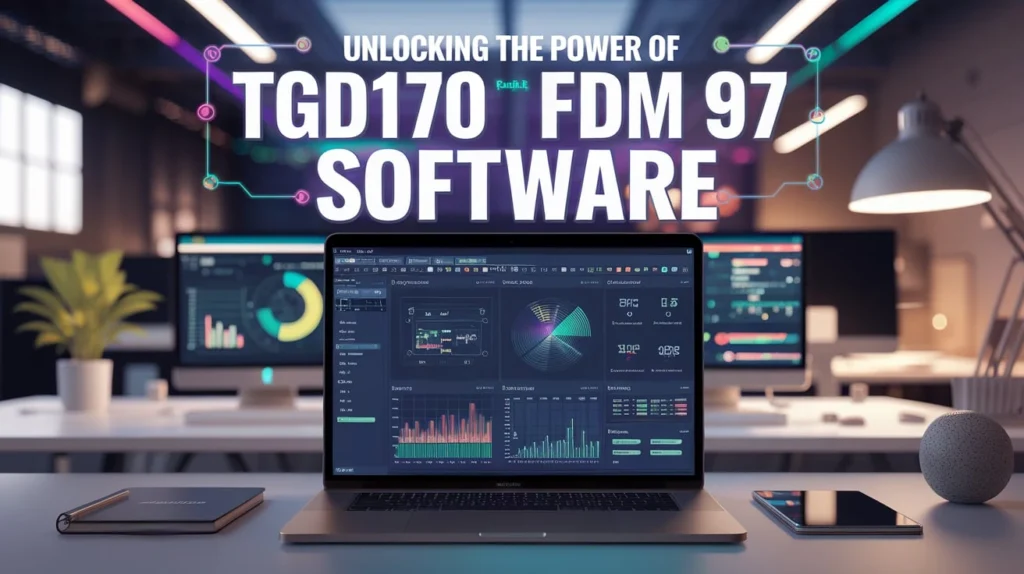
In today’s fast‑moving digital era, finding the right tool to manage complex workflows and data streams is everything. Enter TGD170 FDM 97 software — a powerful platform that promises to streamline operations, boost efficiency, and serve as a strong backbone for modern enterprises. If you’ve been searching for a robust software solution that can unify data‑flows, automate tasks and integrate seamlessly into your operations, you’re about to discover why this suite deserves your attention.
In this deep‑dive article, we’ll explore what TGD170 FDM 97 software is, what makes it compelling, how to assess and implement it, and what its practical benefits are — all written in a clear, professional tone designed for decision‑makers, IT managers and business strategists alike.
What Is TGD170 FDM 97 Software?
When we talk about TGD170 FDM 97 software, we’re referring to an advanced platform designed to orchestrate, manage and optimise data‑driven workflows across enterprise environments. According to one recent overview:
“TGD170.FDM.97 is a high‑powered data flow management software designed to optimise processing pipelines across various platforms.” Radical Blog+2Ido Business+2 The name breaks down roughly as:
- TGD170: the version/edition or product line identifier.
- FDM: here interpreted as Flexible Data Management (or “Flow Data Management”) in this context. Radical Blog+1
- 97: likely indicating the build version, release year or revision number.
In simpler terms: it’s a software tool built for large‑scale process automation, data orchestration, real‑time analytics and integration.
Key Characteristics
Here are the primary traits of the platform:
- Enterprise‑grade workflow automation, including event‑driven triggers, dynamic job routing, retry logic and monitoring. Radical Blog+1
- Dashboard and analytics architecture, giving visibility into pipeline performance, error rates, latencies and bottlenecks. Radical Blog+1
- Integration capability: APIs, web‑hooks, modular structure designed to plug into existing systems (on‑premise, cloud, hybrid). Ido Business
- Emphasis on reliability, performance optimisation, and future‑proof design (scalability, modularity, security). Radical Blog
Why the Name Matters
The naming convention gives you a hint that this isn’t a casual consumer app—it’s built for mission‑critical business operations. The “170” indicates maturity; “FDM” suggests data‑flow/management; “97” may reference legacy compatibility or a version milestone.
Why Businesses Are Choosing TGD170 FDM 97 Software
Why should your organisation pay attention to this platform? Let’s explore how it stacks up in today’s business environment.
Addressing Workflow Complexity
In many modern enterprises, workflows are fragmented—data comes from multiple sources, tasks are chained across departments, and bottlenecks hide in manual handoffs. TGD170 FDM 97 helps by providing a centralised engine to manage that complexity. One article states: “The tgd170.fdm.97 new release … integrates tools that automate, synchronise, and intelligently route work processes across departments.” Ido Business This means you can reduce manual dependencies, provide real‑time monitoring and gain better control of the end‑to‑end process.
Performance & Cost Efficiency
Speed matters. According to release notes:
“Printing complex objects can take hours or even days with conventional methods. This software … cuts printing time by nearly 30%.” LIDNews While that example is specific to additive manufacturing, the principle holds across data‑workflow: fewer waits, faster turnaround, less waste. For data‑heavy or process‑intensive operations, that translates to measurable cost savings and competitive edge.
Enhanced Integration & Digital Transformation
Modern business ecosystems demand flexibility. Compatibility with legacy systems, cloud platforms, modular architecture—it all matters. The TGD170 FDM 97 release emphasises being “future‑proof” and transformation‑ready:
“Supports integration via APIs, webhooks and data synchronisation protocols … seamless coexistence with both legacy and modern infrastructure.” Ido Business+1 For organisations looking to transition systems, adopt DevOps, or engage in digital transformation, having such a platform is a strategic asset.
Improved Governance & Visibility
From an IT governance perspective: audit trails, role‑based access, real‑time dashboards, alerting—all these matter. One announcement highlights:
“Encrypted in‑use memory, fresh audit trail features: Every action logs contextual metadata, timestamp, user, environment and pre/post states.” Radical Blog Those are big wins when it comes to compliance, security and operational transparency.
Core Features of TGD170 FDM 97 Software
Let’s map out the key modules and features you’ll find in this solution—how they work, and what they offer.
ModuleDescriptionBusiness BenefitSmart Processing Engine (SPE)Adaptive workflow balancing, dynamic retry logic, predictive error mitigation. Radical BlogFewer failures, more uptime, less manual intervention.API & Integration LayerCRUD endpoints for metadata, user profiles, job configurations; built‑in webhooks (Slack, Teams, HTTP(S)). BlogSmooth connectivity, modern ecosystem readiness.Dashboard & AnalyticsReal‑time insights on job queues, latency, error‑rates; drag‑and‑drop widgets. Radical Blog+1Better situational awareness, faster decision making.Modular ArchitectureBusiness picks only the components needed: document management, audit tracking, workflow visualisation. Ido BusinessLower complexity, scalable deployment, cost effective.Data Management & ValidationMulti‑source integration, data validation engine, real‑time sync. Ido BusinessEnsures data integrity, supports regulatory compliance.Security & GovernanceRole‑based access, encrypted in‑use memory, full audit trail. Radical BlogHigh trust, enterprise‑grade security.
Feature Highlights to Watch
- Adaptive workflow balancing: The engine auto‑tunes resource loads across CPU, memory, I/O. Radical Blog
- Dynamic retry logic: System learns from error types and adjusts retry intervals. Radical Blog
- Drag‑and‑drop dashboards: Users customise their widgets, layouts, views. Radical Blog
- Modular deployment: Activate only needed modules (e.g., compliance, doc‑mgmt, workflow). Ido Business
- Cloud & hybrid support: Compatible with major OSes, Docker, Helm charts, plus APIs. Radical Blog+1
Who Should Use TGD170 FDM 97 Software?
Not every company needs every feature of a high‑end workflow/data‑management platform—but there are clear profiles and use‑cases where this software is especially powerful.
Ideal Use‑Cases
- Large‑scale enterprises running many interlinked workflows (finance, logistics, manufacturing, healthcare) where process bottlenecks and data silos exist.
- Industries requiring high reliability and governance, such as aerospace, logistics, regulated markets (e.g., compliance‑intensive tasks).
- Organisations undergoing digital transformation, looking to move from legacy systems to modern, integrated platforms.
- Data‑centric operations, where volume, velocity and variety of data require central orchestration and control.
Who may not need it
- Very small businesses with simple workflows may find the full feature‑set over‑engineered.
- Companies with minimal data‑flows and basic automation needs might prefer lighter‑weight tools.
How to Assess & Implement TGD170 FDM 97 Software
Deploying a platform like TGD170 FDM 97 requires thoughtful planning and execution. Below is a step‑by‑step roadmap.
Pre‑Evaluation
- Define business objectives: What are the pain‑points (slow workflows, manual handoffs, error rates, data silos)?
- Map current workflows: Document how data moves, where manual tasks exist, where bottlenecks lie.
- Technical environment audit: Assess current infrastructure, data sources, systems, legacy dependencies.
- Stakeholder alignment: Ensure buy‑in from IT, operations, data‑governance, finance.
Vendor & Feature Fit
- Create a feature checklist based on organisational needs (e.g., adaptive processing engine, dashboards, modularity).
- Evaluate the fit of TGD170 FDM 97 vs alternatives: pricing, support, scalability, licence model.
- Request proof of concept or pilot to test workflow automation, integration, dashboards.
Implementation Strategy
Use a phased rollout approach:
- Step 1: Backup & Staging – Deploy into a test/staging environment, replicate core workloads. Radical Blog
- Step 2: Performance Baseline – Run current workflows, record KPIs (execution time, error rates, resource usage).
- Step 3: Validation Testing – Test major workflows, integration points, dashboards, error handling.
- Step 4: Canary/Cut‑over – Move a subset of production workflows onto the new system, monitor closely.
- Step 5: Full Deployment & Decommissioning – Once stable, switch over remaining workflows, retire redundant legacy systems.
Change Management & Training
- Provide user training, documentation, and role‑specific guidance.
- Design dashboards and views tailored for different teams (operations, IT, executives).
- Monitor adoption, gather feedback and refine workflows accordingly.
Post‑Deployment Monitoring & Optimisation
- Use the built‑in dashboards to track KPIs: job latency, error rates, resource utilisation, user activity.
- Continuously refine processes: disable unused modules, tune retry logic, adjust dashboards.
- Review governance logs, access controls and ensure compliance requirements are being met.
Practical Benefits & ROI
Enhanced Efficiency
- Reduced manual hand‑offs and human error due to more automated workflows.
- Faster processing and reduced wait times. For example: “printing complex objects … cut printing time by nearly 30%” (in a manufacturing context) when using TGD170 FDM 97. LIDNews
- Centralised dashboards reduce time spent by managers chasing reports from multiple systems.
Cost Savings
- Less wasted time => lower labour cost.
- Fewer error‑related reworks or process failures.
- More efficient use of compute / infrastructure resources thanks to adaptive engines.
Improved Control & Visibility
- Real‑time monitoring means issues are flagged early, not after the fact.
- Audit trails and governance capabilities reduce risk and improve compliance posture.
- Cross‑department visibility allows better decision‑making and alignment.
Scalability & Future‑Proofing
- Modular architecture lets you expand as business grows; you don’t have to buy everything upfront.
- Integration capability means you can plug into new systems (cloud, hybrid) without ripping everything out.
- By adopting a robust workflow orchestration platform, the organisation positions itself for further digital transformation.
Challenges, Risks & Mitigation
No software roll‑out is entirely risk‑free. Here are typical challenges and how to address them.
RiskMitigationLegacy system integration issuesPerform upfront audit of data sources; use pilot testing; ensure APIs/webhooks are compatible.Change resistance from usersProvide training, build early successes, involve champions from each department.Process definition gapsMap workflows thoroughly; establish process owners; measure baseline KPIs.Over‑complex deploymentStart with core modules; incrementally add features rather than big bang.Cost overrunsClarify licensing, infrastructure cost; track ROI via metrics (time saved, error rate reduction).
How TGD170 FDM 97 Software Compares to Alternatives
While many workflow/data‑orchestration tools exist, TGD170 FDM 97 distinguishes itself in a few ways:
- Enterprise focus: Many tools serve small‑to‑mid markets; this one emphasises large‑scale workflows, data‑heavy operations.
- Modularity + integration: Built with the idea of adding only what you need, and integrating with existing ecosystems.
- Performance & intelligence: Adaptive engines and predictive retry logic are more advanced than many generic workflow tools.
- Governance + security built‑in: As opposed to add‑ons, these are baked into the tool. That said, your choice must always hinge on your organisation’s size, complexity and future strategy.
Implementation Checklist for Decision‑Makers
Here’s a go‑to checklist to help you evaluate and implement TGD170 FDM 97 software.
- Define top‑3 business problems you expect the software to solve (e.g., manual delays, data silos, error‑rates).
- Identify all major workflows (>50% of workload) and their performance metrics.
- Inventory existing systems (ERP, CRM, database, cloud services) and assess integration readiness.
- Request vendor demo centred on your use‑cases: automation engine, dashboards, data validation.
- Build a cost vs benefit model: licence + infra cost vs time saved + error reduction + productivity gains.
- Plan deployment phases: staging, pilot, full rollout, with clear KPIs.
- Schedule user training and change‑management plan.
- Define monitoring & governance protocol: what will you track after 30/60/90 days?
- Assign ownership: workflow‑owner, IT lead, data‑governance lead.
- Review long‑term roadmap: how this platform fits your 2‑5 year digital strategy.
FAQs
Here are five common questions about TGD170 FDM 97 software — with straight‑forward answers to boost your understanding.
What industries benefit most from TGD170 FDM 97 software?
Industries handling large data‑flows, complex workflows or requiring high reliability: manufacturing, logistics, finance, healthcare, industrial automation. Radical Blog+2Ido Business+2
Is TGD170 FDM 97 compatible with cloud platforms like AWS, Azure, Google Cloud?
Yes — the platform is designed for hybrid deployment, supports APIs and webhooks, and integrates with modern cloud infrastructure. Ido Business+1
How steep is the learning curve for new users?
While advanced in capability, the release emphasises an intuitive UI: drag‑and‑drop dashboards, modular activation. One article claims users can become proficient within ~1 week of training. Ido Business
What are the key metrics to track after implementation?
Key metrics include: workflow execution time, error/failure rate, resource utilisation (CPU/Memory/I/O), number of manual handoffs reduced, number of users/dashboards active, ROI (time saved vs cost).
Does the platform allow migration from earlier versions (for instance version 169 to version 170)?
Yes. According to release notes: “Compatibility with version 169 is seamless; config files and job definitions auto‑migrate.” Radical Blog
Conclusion
In an era where efficiency, data‑visibility and agile workflows differentiate market‑leading organisations from the rest, adopting the right software backbone is a strategic decision. The TGD170 FDM 97 software platform offers a compelling proposition: enterprise‑grade automation, deep integration capability, modular structure, and governance built‐in from the ground up.
If your organisation is grappling with fragmented workflows, manual processes, data silos or outdated systems, this is a toolset worth serious evaluation. The roadmap is clear: define your objectives, map your workflows, pilot the system, measure performance, and then scale.
The take‑away: this isn’t just about software—it’s about enabling transformation. With TGD170 FDM 97 in your operations stack, you’re not simply doing things faster and cheaper—you’re setting up your business for smarter, more resilient, future‑proof growth.