If you’re juggling multiple debts and deadlines, the term “Traceloans.com debt consolidation” may have crossed your mind. And for good reason: more and more people are turning to one‑stop solutions to simplify their finances, regain control, and reduce stress.
In this article, we’ll explore how Traceloans.com debt consolidation works, its benefits and risks, how to decide if it’s right for you, and practical steps toward financial recovery. This isn’t a fluff piece—this is a detailed, high‑value guide aimed to help you make an informed decision.
What Is Debt Consolidation?
Before diving into Traceloans.com, it’s essential to understand the concept of debt consolidation in general.
Definition & Purpose
Debt consolidation is the process of combining multiple debts (credit card balances, personal loans, perhaps store accounts) into a single new loan or payment arrangement. Typically:
- You take out a new loan (or use a service) and apply it to pay off your other debts.
- You end up with one payment each month instead of many.
- Ideally, you get better terms: lower interest rate, longer term, or more manageable payment.
As the UK charity StepChange Debt Charity explains:
“Debt consolidation joins all your debts together … it means there is only one monthly payment to make.” StepChange
How It Typically Works
Here is a simplified table outlining the typical process:
StepDescription1. AssessmentYou list all your debts: credit cards, loans, etc.2. New Loan/SolutionYou apply for a consolidation loan or use a service like Traceloans.com to obtain one.3. Pay Off Existing DebtsThe new loan funds are used to pay off the old accounts.4. Single PaymentYou now owe one lender/service, one monthly payment.5. Repayment & Habit ChangeYou follow your repayment plan—and ideally avoid adding new debt.
Why People Consider It
- Simplification: managing one payment instead of many.
- Potential interest savings: if the new rate is lower than the average of current debts.
- Potential psychological relief: fewer deadlines, fewer creditors calling.
- A chance to reorganize finances and reset behaviour.
Key Things to Check
- Are you still paying more interest overall? A longer term might lower monthly payment but raise total cost. StepChange
- Are you closing old accounts or simply adding another payment—thus risking more debt?
- Is your credit score affected (positively or negatively) by the consolidation?
- Do you have a long‑term plan for not accumulating more debt?
Introducing Traceloans.com Debt Consolidation
Now let’s zoom in on Traceloans.com and how this platform presents debt consolidation to borrowers.
What is Traceloans.com?
Traceloans.com appears to be a digital platform that helps borrowers consolidate debt by connecting them with lenders and offering tools for managing the process. For example:
- According to one article: “Traceloans.com has transformed debt consolidation through a seamless digital experience that pairs borrowers with tailored financial solutions.” BTCC
- The platform claims to provide a three‑step process: quick application, lender matching, and flexible selection of terms. BTCC
How the Traceloans.com Approach Works
Here is a breakdown of how the service is described to operate:
- Application – The borrower completes a form with their financial details.
- Matching – The platform’s algorithm matches the borrower to a network of lending partners, seeking the best terms.
- Selection & Repayment – The borrower chooses the loan suit, consolidates debt into a single payment, and uses tools (dashboard, trackers) to monitor progress.
- Support/Tools – Additional features include repayment planners, progress trackers, coaching. BTCC
Claimed Benefits of Using Traceloans.com
- Streamlined one‑payment structure reducing administrative hassle and risk of missed payments.
- Potential for competitive interest rates through multiple lenders being compared.
- Digital ease: faster application, fewer paper forms.
- Added behavioural and monitoring tools to support better financial habits.
Potential Considerations / Risks
- Eligibility: Not all borrowers will qualify for the best rates; your credit profile and debt‑to‑income matter.
- Cost of extension: If you reduce monthly payment by extending the term, you may pay more in total interest.
- Behaviour change required: Consolidation doesn’t automatically stop you from accruing new debt. In fact, one warning is people end up deeper in debt if they treat consolidation as a magic bullet. StepChange+1
- Be sure the service & lender are transparent about fees, rates, and conditions (especially since much of the detail may vary by country/region).
Is Traceloans.com Debt Consolidation Right for You?
Deciding whether Traceloans.com is a suitable solution depends on your unique situation. Let’s walk through some criteria and questions.
Self‑Assessment Checklist
Consider the following questions before proceeding:
- Do you have multiple debts (e.g., three or more credit cards, personal loans) with different lenders and varying interest rates?
- Is your current monthly payment burden difficult to manage (too many separate payments, risk of missing one)?
- Do you have a stable income and believe you can commit to a single monthly payment for the new loan term?
- Can you secure a consolidated rate that is lower than your current weighted average interest rate? If not, you might not save money.
- Are you prepared to change your spending/borrowing habits so you don’t accumulate new debt after consolidation?
- Have you checked and understood all fees, terms, conditions of the consolidation service (including with Traceloans.com)?
- Is your credit profile in a shape that allows you to access decent rates? If your credit is poor, the new loan may still carry high rates. LendingTree+1
Comparative Table: When It Makes Sense vs. When It May Not
SituationMakes senseMay not make senseYou have high‑interest debts (e.g., > 20‑30% APR) across multiple accounts; you could get a lower consolidated rate.If your current debts are already low interest, consolidation may offer little benefit.You have regular income and can commit to a repayment plan over the agreed term.If your income is unstable or you expect major changes (job loss, large upcoming expense).You are disciplined and ready to avoid taking on new debt while repaying.If you expect to use credit again soon (and thus risk re‑accumulating debt).Your average interest and monthly payment are high and complex to manage.If you only have one or two debts, and rewriting may cost more in fees or extended time.The consolidation service (Traceloans.com) offers transparent terms, competitive rate, and you’ve compared alternatives.If the terms are unclear, rates are only marginally better, or you’re pressured to sign quickly.
Other Factors To Explore
- Term length: A longer term may reduce monthly payment but increase total interest paid.
- Fees: Setup fees, origination fees, closing fees, pre‑payment penalties.
- Credit score impact: A new loan triggers a credit enquiry (which may reduce your score temporarily); on the other hand, consolidating and paying on time can boost your score over time. StepChange+1
- Alternative solutions: Before consolidation, check if debt management plan, balance transfer card, or negotiation might be viable.
Step‑by‑Step: How to Use Traceloans.com for Debt Consolidation
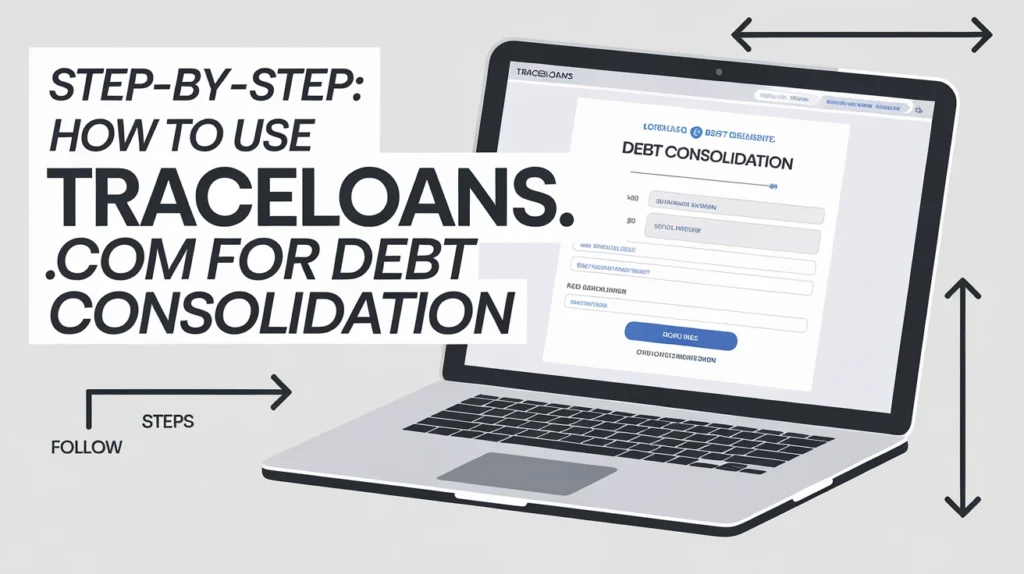
Here’s a structured guide you can follow if you are thinking of going ahead with Traceloans.com debt consolidation:
Step 1: Gather Your Debt Information
Collect details of all debts you wish to consolidate:
- Outstanding balances for each account
- Interest rates (APR) for each
- Monthly payment amounts
- Repayment term remaining
- Any fees or penalties for early payoff
Step 2: Estimate Potential Savings
Create a simple table:
AccountBalanceAPRMonthly PaymentRemaining TermCredit Card A$ XY%$ X1N monthsLoan B$ YZ%$ Y1M months……………Total$ T—$ P (sum of payments)—
Then compare this with a single loan scenario:
- New loan amount: $T (or slightly more/less depending on fees)
- Expected interest rate: (based on quotes via Traceloans.com)
- Term: e.g., 36, 48, 60 months
- New monthly payment: calculate based on rate & term
- Total interest & fees: estimate how much you’ll pay overall
See if the consolidation offers:
- A lower monthly payment, or
- A shorter term (i.e., you pay off faster), or
- A lower overall cost in interest + fees
Step 3: Use Traceloans.com’s Platform
- Visit the Traceloans.com website and complete their application form.
- Provide accurate financial and credit information.
- Select a loan offer (if matched) that meets your budget and goals.
- Ensure you understand the terms: rate, term, fees, monthly payment, payment method, what happens if you miss payments.
- Confirm that the loan funds will indeed pay off your existing debts (not leave residuals).
Step 4: Execute the Consolidation
- Use the funds as agreed (often Traceloans.com or the lender directs funds to your existing creditors).
- Close out or manage your old accounts: if credit cards, consider closing or cutting them up, or at least freezing usage.
- Set up automatic payments for the new consolidated loan to avoid missed payments.
Step 5: Monitor & Manage Post‑Consolidation
- Use Traceloans.com’s dashboard/tools (if provided) to track progress.
- Create a budget to ensure you don’t re‑accumulate debt.
- Keep an eye on your credit report; timely payments help rebuild your credit.
- If you get extra money (bonus, raise), consider making additional payments toward principal (if allowed) to shorten the term and reduce cost.
Pros & Cons of Using Traceloans.com Debt Consolidation
Let’s list the advantages and disadvantages of the service to provide a balanced view.
Pros
- Simplification: One payment instead of many, fewer deadlines and creditor contacts.
- Potential cost savings: If you secure a lower rate or shorter term, you can save money and time.
- Digital/Convenience: Faster application, fewer manual tasks, potentially better user experience.
- Behavioural support: Tools and dashboards help with accountability and monitoring.
- Credit‑building potential: If you make consistent payments, you may improve your score.
Cons
- Rate/term trade‑off: Lower monthly payment may mean longer term—more interest overall.
- Eligibility constraints: Not everyone gets the best rate; credit score and income matter.
- Fees and hidden costs: Setup fees, origination fees, possible penalties for early payoff.
- Post‑consolidation risk: If you don’t change spending habits, you may end up adding new debt and be worse off.
- Dependency on transparency: You must verify the lender, platform, conditions; some services may be less reputable.
Common Mistakes to Avoid When Consolidating with Traceloans.com
When using Traceloans.com (or any consolidation service), watch out for these pitfalls:
- Focusing only on lower monthly payment – Don’t ignore how long the term is or total cost.
- Not closing old credit lines – If you keep using your credit cards, you may undo the consolidation benefits.
- Ignoring your budget / spending habits – Consolidation alone doesn’t fix overspending.
- Skipping the fine print – Understand all fees, late‑payment terms, and what the monthly payment exactly covers.
- Assuming consolidation solves everything – It simplifies payments, but underlying issues (e.g., low income, high expenses) must be addressed.
Tips to Get the Most Out of Traceloans.com Debt Consolidation

To maximize the benefit from your consolidation via Traceloans.com, consider the following strategies:
- Aim for a balance where you reduce monthly payment but don’t excessively lengthen the term.
- Make extra payments when possible (if the loan allows pre‑payments without penalty) to reduce interest and term.
- Create an emergency fund (even a modest one) so you’re less likely to bounce back into high‑interest debt if something unexpected happens.
- Set up automatic payments to avoid missing the new consolidated loan payment.
- Track your debt‑to‑income ratio and credit utilisation; consolidation should help reduce credit utilisation (good for credit score).
- Avoid adding new debt immediately after consolidation; treat unused credit lines with caution.
- Review your budget regularly – know where your money is going, adjust when needed, and cut non‑essential costs.
Internal Linking Suggestions
For SEO and user engagement on your website, you might consider linking to related content, such as:
- An article on “How to Build a Budget When Consolidating Debt”.
- A piece on “Understanding Credit Scores & How Debt Consolidation Affects Them”.
- A guide on “Alternatives to Debt Consolidation: Debt Management Plans & Balance Transfers”.
- A resource page on “Financial Habits to Avoid After Consolidation”.
FAQs
Q1. What is the minimum credit score needed to use Traceloans.com for debt consolidation? A1. The exact minimum score will depend on the lender matched via Traceloans.com. Since consolidation loans generally require credit checks, a higher credit score improves your chances for a better rate. Borrowers with poor credit can still qualify but may face higher interest rates. LendingTree+1
Q2. Will consolidating debt with Traceloans.com hurt my credit score? A2. Initially, applying for a loan will trigger a hard credit inquiry, which may temporarily dip your score. However, if you make payments on time and reduce your overall debt utilisation, your credit score may improve over time. StepChange+1
Q3. Can I still access credit cards or other loans after doing debt consolidation via Traceloans.com? A3. Yes, technically you can—but doing so may undermine the benefit of consolidation. If you keep using credit cards and rack up new balances, you risk increasing your overall debt load rather than reducing it. It’s best to pause and reset your credit habits.
Q4. How much will I save by consolidating with Traceloans.com? A4. The savings depend on your current interest rates, balances, the new loan rate and term. Use the “debt consolidation calculator” to estimate savings. For example, the charity StepChange explains that while consolidation can reduce monthly payments, it may increase total interest if the term is extended. StepChange
Q5. What happens if I miss the payment on my consolidated loan with Traceloans.com? A5. If you miss a payment, you risk late fees, an increased interest rate (depending on lender terms), and negative credit reporting. Since the consolidated loan is replacing your previous debts, you also lose the benefit of simplification. Setting up automatic payments is strongly recommended.
Conclusion
In the world of financial stress and multiple debt obligations, Traceloans.com debt consolidation offers a promising solution: one manageable monthly payment, potential cost savings, and a route to regain control. But it is not a magic “debt‑erase” button. To reap the benefits, you must go in with eyes open—understand your current debt landscape, compare options, secure favourable terms, and most importantly, commit to changing your habits.
If you meet the criteria—multiple high‑interest debts, a stable income, readiness to commit—consolidation via Traceloans.com could be a high‑value move. On the other hand, if your debts are modest, your budget is already tight, or you expect to keep borrowing, alternative solutions might serve you better.
Ultimately, successful consolidation is as much about behaviour change as it is about paperwork. Use it as a launchpad: one payment, one plan, and a future where you’re no longer juggling debts—but investing in your financial freedom.